What factors should you consider when choosing the right cloud infrastructure for your workload? Should you run on bare metal servers or virtual servers, and why does that choice matter? Rather than treating one option better than the other, it’s important to understand how different workload requirements influence this decision. Let’s take a closer look at the key criteria to consider when selecting the most suitable cloud server environment.
The Advantages of Bare Metal Servers
Unlike traditional services that may use virtualization for ease of management, bare metal servers provide direct access to the physical hardware, enabling workloads to utilize CPU, GPU, memory, and storage resources with minimal overhead. As a result, performance remains consistent and predictable, making bare metal environments well suited for long-running and compute-intensive workloads.
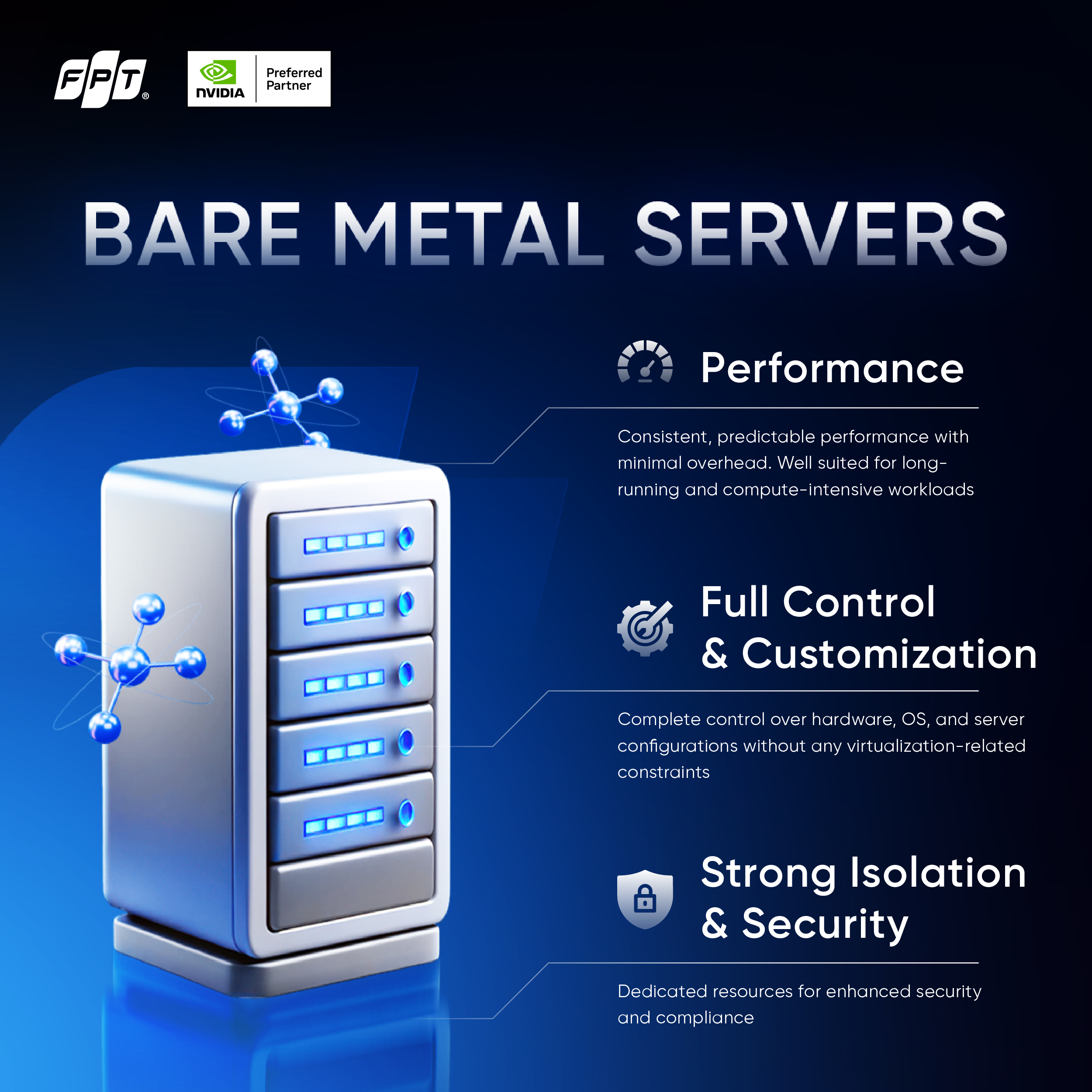
In addition, bare metal servers offer a high degree of control over the computing environment. Therefore, organizations opting for it are able to gain the highest level of control and customization. They can fine-tune server configurations, optimize performance, and install operating systems and software without any virtualization-related constraints. This level of customization is particularly valuable for specialized and performance-sensitive use cases.
Moreover, this cloud infrastructure can also deliver strong isolation, as all hardware resources are dedicated to a single tenant or workload. This isolation supports enhanced security, compliance, and data protection, which are critical considerations for regulated or data-sensitive applications.
The advantages of Virtual Servers
Virtual servers are designed to deliver flexibility and speed. They can be provisioned rapidly and scaled up or down in response to changing workload demands, making them suitable for dynamic environments where resource requirements evolve over time.
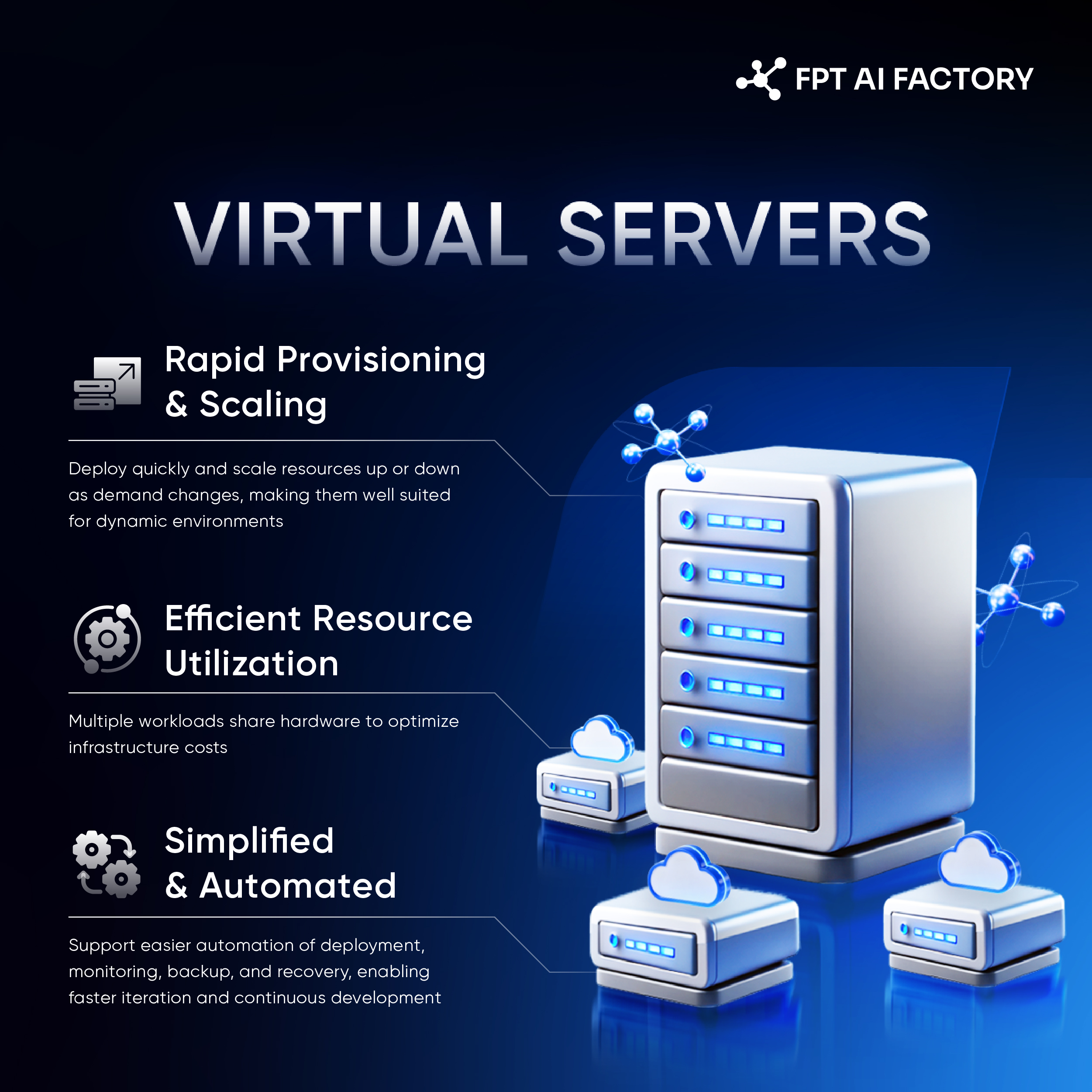
Another key advantage is efficient resource utilization. Virtual servers allow multiple workloads to share underlying hardware, helping organizations optimize costs while maintaining acceptable performance levels.
Virtual environments are also easier to manage and automate. Tasks such as deployment, backup, monitoring, and recovery are often simpler in virtualized setups, supporting rapid iteration and continuous development.
Bare Metal Servers vs. Virtual Servers: Workload and Use Case Considerations
| Bare Metal Servers | Virtual Servers | |
| Primary use case | Maximum performance and predictable resources | Flexibility and rapid deployment |
| Typical workloads | Large-scale AI training, HPC, long-running data processing | Development/testing, experimentation, inference |
| Runtime pattern | Continuous, long-term workloads | Short-lived or bursty workloads |
| Resource access | Full access to GPU memory, storage, and network | Virtualized and shared resources |
| Performance | High and consistent | Varies based on allocation and sharing |
| Operational fit | Strict performance, security, or compliance needs | Agile teams managing multiple environments |
Key Considerations for Infrastructure Selection
When deciding between bare metal and virtual servers, it is important to understand the characteristics of your workloads. Factors such as performance sensitivity, workload duration, scaling needs, and operational complexity should guide the decision.
Cost structure is another consideration. While the short-term cost of running workloads in the cloud may be reduced through the use of virtual servers, this approach often involves trade-offs in areas such as control, performance, and security:
| Bare Metal Servers | Virtual Servers | |
| Cost | No hypervisor overhead, allowing direct control over hardware and system-level configurations | Hypervisor layer consumes some compute resources and adds abstraction |
| Performance | Fully controlled environment with optimized CPU, memory, and storage; ideal for HPC and latency-critical workloads | Performance may be affected by virtualization overhead |
| Security | Single-tenant model with dedicated resources; suitable for strict compliance requirements (GDPR, HIPAA, HITECH, PCI DSS) | Multi-tenant environment with shared resources |
Cost: Virtual server infrastructures rely on hypervisors, which consume some underlying compute resources and introduce an additional abstraction layer. Bare metal environments operate without this overhead, enabling more direct control over hardware and system-level configurations.
Performance: Bare metal servers allow workloads to run in fully controlled environments where CPU, memory, and storage can be optimized to meet application-specific requirements. This level of tuning is particularly valuable for performance-sensitive workloads, including high-performance computing and latency-critical applications commonly found in industries such as financial services.
Security: Bare metal deployments use a single-tenant model with dedicated resources, reducing risks associated with multi-tenant environments. This makes bare metal suitable for workloads that require strong security controls and compliance with data protection regulations such as GDPR, HIPAA, HITECH, and PCI DSS.
To help organizations more easily adopt infrastructure models, FPT AI Factory provides both bare metal and virtualized services called Metal Cloud and GPU Virtual Machine. Both are designed to support a wide range of AI workloads.
The FPT AI Factory Advantages
Metal Cloud enables you to deploy and manage bare metal servers globally. Our platform offers the flexibility of virtualized cloud environments with the performance, security, and control of dedicated.
While GPU Virtual Machine (GPU VM) enables you to deploy and manage high-performance GPU servers with ease. GPU VM uses a passthrough GPU to get a dedicated GPU; applications access it through the layers of a guest OS and hypervisor. Other critical VM resources that applications use, such as RAM, storage, and networking, are also virtualized.